Archive for the ‘Software engineering’ Category.

New course partners sought: a DOSE of software engineering education


Since 2007 we have conducted, as part of a course at ETH, the DOSE project, Distributed and Outsourced Software Engineering, developed by cooperating student teams from a dozen universities around the world. We are finalizing the plans for the next edition, October to December 2013, and will be happy to welcome a few more universities.

The project consists of building a significant software system collaboratively, using techniques of distributed software development. Each university contributes a number of “teams”, typically of two or three students each; then “groups”, each made up of three teams from different universities, produce a version of the project.

The project’s theme has varied from year to year, often involving games. We make sure that the development naturally divides into three subsystems or “clusters”, so that each group can quickly distribute the work among its teams. An example of division into clusters, for a game project, is: game logic; database and player management; user interface. The page that describes the setup in more detail [1] has links enabling you to see the results of some of the best systems developed by students in recent years.

The project is a challenge. Students are in different time zones, have various backgrounds (although there are minimum common requirements [1]), different mother tongues (English is the working language of the project). Distributed development is always hard, and is harder in the time-constrained context of a university course. (In industry, while we do not like that a project’s schedule slips, we can often survive if it does; in a university, when the semester ends, we have to give students a grade and they go away!) It is typical, after the initial elation of meeting new student colleagues from exotic places has subsided and the reality of interaction sets in, that some groups will after a month, just before the first or second deadline, start to panic — then take matters into their own hands and produce an impressive result. Students invariably tell us that they learn a lot through the course; it is a great opportunity to practice the principles of modern software engineering and to get prepared for the realities of today’s developments in industry, which are in general distributed.

For instructors interested in software engineering research, the project is also a great way to study issues of distributed development in  a controlled setting; the already long list of publications arising from studies performed in earlier iterations [3-9] suggests the wealth of available possibilities.

Although the 2013 project already has about as many participating universities as in previous years, we are always happy to consider new partners. In particular it would be great to include some from North America. Please read the requirements on participating universities given in [1]; managing such a complex process is a challenge in itself (as one can easily guess) and all teaching teams must share goals and commitment.

References

[1] General description of DOSE, available here.

[2] Bertrand Meyer: Offshore Development: The Unspoken Revolution in Software Engineering, in Computer (IEEE), January 2006, pages 124, 122-123, available here.

[3] Bertrand Meyer and Marco Piccioni: The Allure and Risks of a Deployable Software Engineering Project: Experiences with Both Local and Distributed Development, in Proceedings of IEEE Conference on Software Engineering & Training (CSEE&T), Charleston (South Carolina), 14-17 April 2008, available here.

[3] Martin Nordio, Roman Mitin, Bertrand Meyer, Carlo Ghezzi, Elisabetta Di Nitto and Giordano Tamburelli: The Role of Contracts in Distributed Development, in Proceedings of Software Engineering Advances For Offshore and Outsourced Development, Lecture Notes in Business Information Processing 35, Springer-Verlag, 2009, available here.

[4] Martin Nordio, Roman Mitin and Bertrand Meyer: Advanced Hands-on Training for Distributed and Outsourced Software Engineering, in Proceedings of the 32nd ACM/IEEE International Conference on Software Engineering – Volume 1, ACM. 2010 available here.

[5] Martin Nordio, Carlo Ghezzi, Bertrand Meyer, Elisabetta Di Nitto, Giordano Tamburrelli, Julian Tschannen, Nazareno Aguirre and Vidya Kulkarni: Teaching Software Engineering using Globally Distributed Projects: the DOSE course, in Collaborative Teaching of Globally Distributed Software Development – Community Building Workshop (CTGDSD — an ICSE workshop), ACM, 2011, available here.

[6] Martin Nordio, H.-Christian Estler, Bertrand Meyer, Julian Tschannen, Carlo Ghezzi, and Elisabetta Di Nitto: How do Distribution and Time Zones affect Software Development? A Case Study on Communication, in Proceedings of the 6th International Conference on Global Software Engineering (ICGSE), IEEE, pages 176–184, 2011, available here.

[7] H.-Christian Estler, Martin Nordio, Carlo A. Furia, Bertrand Meyer and Johannes Schneider: Agile vs. Structured Distributed Software Development: A Case Study, in Proceedings of the 7th International Conference on Global Software Engineering (ICGSE’12) IEEE, pages 11–20, 2012, available here.


VN:F [1.9.10_1130]
Rating: 0.0/10 (0 votes cast)
VN:F [1.9.10_1130]
Rating: 0 (from 0 votes)

Reading notes: misclassified bugs


(Please note the general disclaimer [1].)

How Misclassification Impacts Bug Prediction [2], an article to be presented on Thursday at ICSE, is the archetype of today’s successful empirical software engineering research, deriving significant results from the mining of publicly available software project repositories — in this case Tomcat5 and three others from Apache, as well as Rhino from Mozilla. The results are in some sense meta-results, because many studies have already mined the bug records of such repositories to draw general lessons about bugs in software development; what Herzig, Just and Zeller now tell us is that the mined data is highly questionable: many problems classified as bugs are not bugs.

The most striking results (announced in a style a bit stentorian to my taste, but indeed striking) are that: every third bug report does not describe a bug, but a request for a new feature, an improvement, better documentation or tests, code cleanup or refactoring; and that out of five program files marked as defective, two do not in fact contain any bug.

These are both false positive results. The repositories signal very few misclassifications the other way: only a small subset of enhancement and improvement requests (around 5%) should have been classified as bugs, and even fewer faulty files are missed (8%, but in fact less than 1% if one excludes an outlier, tomcat5 with 38%, a discrepancy that the paper does not discuss).

The authors have a field day, in the light of this analysis, of questioning the validity of the many studies in recent years — including some, courageously cited, by Zeller himself and coauthors — that start from bug repositories to derive general lessons about bugs and their properties.

The methodology is interesting if a bit scary. The authors (actually, just the two non-tenured authors, probably just a coincidence) analyzed 7401 issue reports manually; more precisely, one of them analyzed all of them and the second one took a second look at the reports that came out from the first step as misclassified, without knowing what the proposed reclassification was, then the results were merged. At 4 minutes per report this truly stakhanovite effort took 90 working days. I sympathize, but I wonder what the rules are in Saarland for experiments involving living beings, particularly graduate students.

Precise criteria were used for the reclassification; for example a report describes a bug, in the authors’ view, if it mentions a null pointer exception (I will skip the opportunity of a pitch for Eiffel’s void safety mechanism), says that the code has to be corrected to fix the semantics, or if there is a “memory issue” or infinite loop. These criteria are reasonable if a bit puzzling (why null pointer exceptions and not other crashes such as arithmetic overflows?); but more worryingly there is no justification for them. I wonder  how much of the huge discrepancy found by the authors — a third or reported bugs are not bugs, and 40% of supposedly defective program files are not defective — can be simply explained by different classification criteria applied by the software projects under examination. The authors give no indication that they interacted with the people in charge of these projects. To me this is the major question hovering over this paper and its spectacular results. If you are in the room and get the chance, don’t hesitate to ask this question on my behalf or yours!

Another obvious question is how much the results depend on the five projects selected. If there ever was room for replicating a study (a practice whose rarity in software engineering we lament, but whose growth prospects are limited by the near-impossibility of convincing selective software engineering venues to publish confirmatory empirical studies), this would be it. In particular it would be good to see some of the results for commercial products.

The article offers an explanation for the phenomena it uncovered: in its view, the reason why so many bug reports end up misclassified is the difference of perspective between users of the software, who complain about the problems they encounter,  and the software professionals  who prepare the actual bug reports. The explanation is plausible but I was surprised not to see any concrete evidence that supports it. It is also surprising that the referees did not ask the authors to provide more solid arguments to buttress that explanation. Yet another opportunity to raise your hand and ask a question.

This (impressive) paper will call everyone’s attention to the critical problem of data quality in empirical studies. It is very professionally prepared, and could, in addition to its specific contributions, serve as a guide on how to get an empirical software engineering paper accepted at ICSE: take a critical look at an important research area; study it from a viewpoint that has not been considered much so far; perform an extensive study, with reasonable methodological assumptions; derive a couple of striking results, making sure they are both visibly stated and backed by the evidence; and include exactly one boxplot.

Notes and references

[1] This article review is part of the “Reading Notes” series. General disclaimer here.

[2] Kim Herzig, Sascha Just and Andreas Zeller: It’s not a Bug, it’s a Feature: How Misclassification Impacts Bug Prediction, in ICSE 2013, available here. According to the ICSE program the paper will be presented on May 23 in the Bug Prediction session, 16 to 17:30.

VN:F [1.9.10_1130]
Rating: 10.0/10 (1 vote cast)
VN:F [1.9.10_1130]
Rating: +1 (from 1 vote)

Reading notes: the design of bug fixes


To inaugurate the “Reading Notes” series [1] I will take articles from the forthcoming International Conference on Software Engineering. Since I am not going to ICSE this year I am instead spending a little time browsing through the papers, obligingly available on the conference site. I’ll try whenever possible to describe a paper before it is presented at the conference, to alert readers to interesting sessions. I hope in July and August to be able to do the same for some of the papers to be presented at ESEC/FSE [2].

Please note the general disclaimer [1].

The Design of Bug Fixes [3] caught my attention partly for selfish reasons, since we are working, through the AutoFix project [3], on automatic bug fixing, but also out of sheer interest and because I have seen previous work by some of the authors. There have been article about bug patterns before, but not so much is known with credible empirical evidence about bug fixes (corrections of faults). When a programmer encounters a fault, what strategies does he use to correct it? Does he always produce the best fix he can, and if so, why not? What is the influence of the project phase on such decisions (e.g. will you fix a bug the same way early in the process and close to shipping)? These are some of the questions addressed by the paper.

The most interesting concrete result is a list of properties of bug fixes, classified along two criteria: nature of a fix (the paper calls it “design space”), and reasoning behind the choice of a fix. Here are a few examples of the “nature” classification:

  • Data propagation: the bug arises in a component, fix it in another, for example a library class.
  • More or less accuracy: are we fixing the symptom or the cause?
  • Behavioral alternatives: rather than directly correcting the reported problem, change the user-experienced behavior (evoking the famous quip that “it’s not a bug, it’s a feature”). The authors were surprised to see that developers (belying their geek image) seem to devote a lot of effort trying to understand how users actually use the products, but also found that even so developers do not necessarily gain a solid, objective understanding of these usage patterns. It would be interesting to know if the picture is different for traditional locally-installed products and for cloud-based offerings, since in the latter case it is possible to gather more complete, accurate and timely usage data.

On the “reasoning” side, the issue is why and how programmers decide to adopt a particular approach. For example, bug fixes tend to be more audacious (implying redesign if appropriate) at the beginning of a project, and more conservative as delivery nears and everyone is scared of breaking something. Another object of the study is how deeply developers understand the cause rather than just the symptom; the paper reports that 18% “did not have time to figure out why the bug occurred“. Surprising or not, I don’t know, but scary! Yet another dimension is consistency: there is a tension between providing what might ideally be the best fix and remaining consistent with the design decisions that underlie a software system throughout its architecture.

I was more impressed by the individual categories of the classification than by that classification as a whole; some of the categories appear redundant (“interface breakage“, “data propagation” and “internal vs external“, for example, seem to be pretty much the same; ditto for “cause understanding” and “accuracy“). On the other hand the paper does not explicitly claim that the categories are orthogonal. If they turn this conference presentation into a journal article I am pretty sure they will rework the classification and make it more robust. It does not matter that it is a bit shaky at the moment since the main insights are in the individual kinds of fix and fix-reasoning uncovered by the study.

The authors are from Microsoft Research (one of them was visiting faculty) and interviewed numerous programmers from various Microsoft product groups to find out how they fix bugs.

The paper is nicely written and reads easily. It includes some audacious syntax, as in “this dimension” [internal vs external] “describes how much internal code is changed versus external code is changed as part of a fix“. It has a discreet amount of humor, some of which may escape non-US readers; for example the authors explain that when approaching programmers out of the blue for the survey they tried to reassure them through the words “we are from Microsoft Research, and we are here to help“, a wry reference to the celebrated comment by Ronald Reagan (or his speechwriter) that the most dangerous words in the English language are “I am from the government, and I am here to help“. To my taste the authors include too many details about the data collection process; I would have preferred the space to be used for a more detailed discussion of the findings on bug fixes. On the other hand we all know that papers to selective conferences are written for referees, not readers, and this amount of methodological detail was probably the minimum needed to get past the reviewers (by avoiding the typical criticism, for empirical software engineering research, that the sample is too small, the questions biased etc.). Thankfully, however, there is no pedantic discussion of statistical significance; the authors openly present the results as dependent on the particular population surveyed and on the interview technique. Still, these results seem generalizable in their basic form to a large subset of the industry. I hope their publication will spawn more detailed studies.

According to the ICSE program the paper will be presented on May 23 in the Debugging session, 13:30 to 15:30.

Notes and references

[1] This article review is part of the “Reading Notes” series. General disclaimer here.

[2] European Software Engineering Conference 2013, Saint Petersburg, Russia, 18-24 August, see here.

[3] Emerson Murphy-Hill, Thomas Zimmerman, Christian Bird and Nachiappan Nagapan: The Design of Bug Fixes, in ICSE 2013, available here.

[4] AutoFix project at ETH Zurich, see project page here.

[5] Ronald Reagan speech extract on YouTube.

VN:F [1.9.10_1130]
Rating: 10.0/10 (1 vote cast)
VN:F [1.9.10_1130]
Rating: +1 (from 1 vote)

Adult entertainment


I should occasionally present examples of the strange reasons people sometimes invoke for not using Eiffel. In an earlier article [1] I gave the basic idea common to all these reasons, but there are many variants, in the general style “I am responsible for IT policy and purchases for IBM, the US Department of Defense and Nikke, and was about to sign the PO for the triple site license when I noticed that an article about Eiffel was published in 1997. How dare you! I had a tooth removed that year and it hurt a lot. I would really have liked to use Eiffel but you just made it impossible“.

While going through old email I found one of these carefully motivated strategic policy decisions: a missing “L” in a class name. Below is, verbatim [2], a message posted on the EiffelStudio developers list in 2006, and my answer. Also provides an interesting glimpse of what supposedly grown-up people find it worthwhile to spend their days on.

Original message

From: es-devel-bounces@origo.ethz.ch [mailto:es-devel-bounces@origo.ethz.ch] On Behalf Of Peter Gummer
Sent: Tuesday, 29 August, 2006 14:01
To: es-devel@origo.ethz.ch
Subject: [Es-devel] Misspelling as a naming convention
Today I submitted a problem report that one of the EiffelVision classes has misspelt “tabbable” as “tabable“.

From: es-devel-bounces@origo.ethz.ch [mailto:es-devel-bounces@origo.ethz.ch] On Behalf Of Peter GummerManu replied that the EiffelVision naming convention is that class or feature names ending in “able” will not double the preceding consonant, regardless of whether this results in wrong spelling.

Looking at the latest Es-changes Digest email, I see various changes implementing this naming convention. For example, the comment for revision 63043 is, “Changed from controllable to controlable to meet naming convention‘.

This is lunacy! “Controlable” (implying the existence of some verb “to controle“) might look quite ok to French eyes, but it looks utterly unprofessional to me. It does have a sort of Chaucerian, Middle English, pre-Gutenberg charm I suppose. Is this part of a plot for a Seconde Invasion Normande of the Langue Anglaise?

We are about to embark on some GUI work. Although we are probably going to use .NET WinForms, EiffelVision was a possible choice. But bad spelling puts me in a bad mood. I’d be very reluctant to work with EiffelVision because of this ridiculous naming convention.

- Peter Gummer

Answer

From: Bertrand Meyer
Sent: Wednesday, 30 August, 2006 00:52
To: Peter Gummer
Cc: es-devel@origo.ethz.ch
Subject: Re: [Es-devel] Misspelling as a naming convention

This has nothing to do with French. If anything, French practices the doubling of consonants before a suffix more than English does; an example (extracted from reports of users’ attitudes towards EiffelVision) is English “passionate“, French “passionné“. For the record, there’s no particular French dominance in the Eiffel development team, either at Eiffel Software or elsewhere. The recent discussion on EiffelVision’s “-able” class names involved one native English speaker out of three people, invalidating at the 33% level Kristen Nygaard’s observation that the language of science is English as spoken by foreigners.

The problem in English is that the rules defining which consonants should be doubled before a suffix such as “able” are not obvious. See for example this page from the University of Ottawa:

Double the final consonant before a suffix beginning with a vowel if both of the following are true: the consonant ends a stressed syllable or a one-syllable word, and the consonant is preceded by a single vowel.

Now close your eyes and repeat this from memory. I am sure that won’t be hard because you knew the rule all along, but can we expect this from all programmers using EiffelVision?

Another Web page , from a school in Oxfordshire, England, says:

Rule: Double the last consonant when adding a vowel suffix to a single syllable word ending in one vowel and one consonant.

Note that this is not quite the same rule; it doesn’t cover multi-syllable words with the stress (tonic accent) on the last syllable; and it would suggest “GROUPPABLE” (“group” is a one-syllable word ending in one vowel and one consonant), whereas the first rule correctly prescribes “GROUPABLE“. But apparently this is what is being taught to Oxfordshire pupils, whom we should stand ready to welcome as Eiffel programmers in a few years.

Both rules yield “TRANSFERABLE” because the stress is on the first syllable of “transfer“. But various dictionaries we have consulted also list “TRANSFERRABLE” and “TRANSFERRIBLE“.

As another example consider “FORMATING“. Both rules suggest a single “t“. The Solaris spell checker indeed rejects the form with two “t“s and accepts the version with one; but — a case of Unix-Windows incompatibility that seems so far to have escaped the attention of textbook authors — Microsoft Word does the reverse! In fact in default mode if you type “FORMATING” it silently corrects it to “FORMATTING“. It’s interesting in this example to note a change of tonic accent between the original and derived words: “fórmat” (both noun and verb) but “formáting“. Maybe the Word convention follows the “Ottawa” rule but by considering the stress in the derivation rather than the root? There might be a master’s thesis topic in this somewhere.

Both rules imply “MIXXABLE” and “FIXXABLE“, but we haven’t found a dictionary that accepts either of these forms.

Such rules cannot cover all cases anyway (they are “UNFATHOMMABLE“) because “consonant” vs “vowel” is a lexical distinction that doesn’t reflect the subtleties of English pronunciation. For example either rule would lead to “DRAWWABLE” because the word “draw” ends with “w“, a letter that you’ll find everywhere characterized as a consonant. Lexically it is a consonant, but phonetically it is sometimes a consonant and sometimes not, in particular at the end of a word. In “Wow“, the first “w” is a consonant, but not the second one. A valid rule would need to take into account not only spelling but also pronunciation. This is probably the reason behind the examples involving words ending in “x“: phonetically “X” can be considered two consonants, “KS“. But then the rule becomes more tricky, forcing the inquirer, who is understandably getting quite “PERPLEXXED” at this stage, to combine lexical and phonetic reasoning in appropriate doses.

No wonder then a page from the Oxford Dictionaries site states:

One of the most common types of spelling error is a mistake over whether a word is spelled with a double or a single consonant.

and goes on to list many examples.

You can find a list of of words ending in “ablehere . Here are a few cases involving derivations from a word ending with “p“:

Single consonant
DEVELOPABLE
GRASPABLE
GROUPABLE
HELPABLE
KEEPABLE
REAPABLE
RECOUPABLE

Doubled consonant
DIPPABLE
DROPPABLE (but: DRAPABLE)
FLOPPABLE
MAPPABLE
RECAPPABLE (but: CAPABLE)
RIPPABLE (but: ROPABLE)
SHIPPABLE
SKIPPABLE
STOPPABLE
STRIPPABLE
TIPPABLE

There are also differences between British and American usage.

True, the “Ottawa” rule could be amended to take into account words ending in “w“, “x“, “h” and a few other letters, and come reasonably close to matching dictionary practice. But should programmers have to remember all this? Will they?

Since we are dealing in part with artificial words, there is also some doubt as to what constitutes a “misspelt” word as you call it (or a “misspelled” one as Eiffel conventions — based on American English — would have it). Applying the rule yields “MAPPABLE“, which is indeed found in dictionaries. But in the world of graphics we have the term “bitmap“, where the stress is on the first syllable. The rule then yields “BITMAPABLE“. That’s suspicious but “GOOGLABLE“; a search produces 31 “BITMAPPABLE” and two “BITMAPABLE“, one of which qualified by “(Is that a word?)”. So either EiffelVision uses something that looks inconsistent (“BITMAPABLE” vs “MAPPABLE“) but follows the rule; or we decide for consistency.

In our view this case can be generalized. The best convention is the one that doesn’t require programmers to remember delicate and sometimes fuzzy rules of English spelling, but standardizes on a naming convention that will be as easy to remember as possible. To achieve this goal the key is consistency. A simple rule for EiffelVision classes is:

  • For an “-able” name derived from a word ending with “e“, drop the “e“: REUSABLE. There seems to be no case of words ending with another vowel.
  • If the name is derived from a word ending with a consonant, just add “able“: CONTROLABLE, TOOLTIPABLE, GROUPABLE.

Some of these might look strange the first couple of times but from then on you will remember the convention.

While we are flattered that EiffelVision should be treated as literature, we must admit that there are better recommendations for beach reading, and that Eiffel is not English (or French).

The above rule is just a convention and someone may have a better suggestion.

With best regards,

– Bertrand Meyer, Ian King, Emmanuel Stapf

Reference and note

[1] Habit, happiness and programming languages, article in this blog, 22 October 2012, see here.

[2] I checked the URLs, found that two pages have disappeared since 2006, and replaced them with others having the same content. The formatting (fonts, some of the indentation) is added. Peter Gummer asked me to make sure that his name always appears with two “m“.

VN:F [1.9.10_1130]
Rating: 10.0/10 (3 votes cast)
VN:F [1.9.10_1130]
Rating: +2 (from 2 votes)

Apocalypse no! (Part 2)


Recycled(Revised from an article originally published in the CACM blog. Part 2 of a two-part article.)

Part 1 of this article (to be found here, please read it first) made fun of authors who claim that software engineering is a total failure — and, like everyone else, benefit from powerful software at every step of their daily lives.

Catastrophism in talking about software has a long history. Software engineering started around 1966 [1] with the recognition of a “software crisis“. For many years it was customary to start any article on any software topic by a lament about the terrible situation of the field, leaving in your reader’s mind the implicit suggestion that the solution to the “crisis” lay in your article’s little language or tool.

After the field had matured, this lugubrious style went out of fashion. In fact, it is hard to sustain: in a world where every device we use, every move we make and every service we receive is powered by software, it seems a bit silly to claim that in software development everyone is wrong and everything is broken.

The apocalyptic mode has, however, made a comeback of late in the agile literature, which is fond in particular of citing the so-called “Chaos” reports. These reports, emanating from Standish, a consulting firm, purport to show that a large percentage of projects either do not produce anything or do not meet their objectives. It was fashionable to cite Standish (I even included a citation in a 2003 article), until the methodology and the results were thoroughly debunked starting in 2006 [2, 3, 4]. The Chaos findings are not replicated by other studies, and the data is not available to the public. Capers Jones, for one, publishes his sources and has much more credible results.

Yet the Chaos results continue to be reverently cited as justification for agile processes, including, at length, in the most recent book by the creators of Scrum [5].

Not long ago, I raised the issue with a well-known software engineering author who was using the Standish findings in a talk. Wasn’t he aware of the shakiness of these results? His answer was that we don’t have anything better. It did not sound like the kind of justification we should use in a mature discipline. Either the results are sound, or we should not rely on them.

Software engineering is hard enough and faces enough obstacles, so obvious to everyone in the industry and to every user of software products, that we do not need to conjure up imaginary scandals and paint a picture of general desolation and universal (except for us, that is) incompetence. Take Schwaber and Sutherland, in their introductory chapter:

You have been ill served by the software industry for 40 years—not purposely, but inextricably. We want to restore the partnership.

No less!

Pretending that the whole field is a disaster and no one else as a clue may be a good way to attract attention (for a while), but it is infantile as well as dishonest. Such gross exaggerations discredit their authors, and beyond them, the ideas they promote, good ones included.

As software engineers, we can in fact feel some pride when we look at the world around us and see how much our profession has contributed to it. Not just the profession as a whole, but, crucially, software engineering research: advances in programming methodology, software architecture, programming languages, specification techniques, software tools, user interfaces, formal modeling of software concepts, process management, empirical analysis and human aspects of computing have, step after step, belied the dismal picture that may have been painfully accurate in the early days.

Yes, challenges and unsolved problems face us at every corner of software engineering. Yes, we are still at the beginning, and on many topics we do not even know how to proceed. Yes, there are lots of things to criticize in current practices (and I am not the least vocal of the critics, including in this blog). But we need a sense of measure. Software engineering has made tremendous progress over the last five decades; neither the magnitude of the remaining problems nor the urge to sell one’s products and services justifies slandering the rest of the discipline.

Notes and references

[1] Not in 1968 with the NATO conference, as everyone seems to believe. See an earlier article in this blog.

[2] Robert L. Glass: The Standish report: does it really describe a software crisis?, in Communications of the ACM, vol. 49, no. 8, pages 15-16, August 2006; see here.

[3] J. Laurens Eveleens and Chris Verhoef: The Rise and Fall of the Chaos Report Figures, in IEEE Software, vol. 27, no. 1, Jan-Feb 2010, pages 30-36; see here.

[4] S. Aidane, The “Chaos Report” Myth Busters, 26 March 2010, see here.

[5] Ken Schwaber and Jeff Sutherland: Software in 30 Days: How Agile Managers Beat the Odds, Delight Their Customers, And Leave Competitors In the Dust, Wiley, 2012.

VN:F [1.9.10_1130]
Rating: 10.0/10 (2 votes cast)
VN:F [1.9.10_1130]
Rating: +2 (from 4 votes)

Specify less to prove more

Software verification is progressing slowly but surely. Much of that progress is incremental: making the fundamental results applicable to real programs as they are built every day by programmers working in standard circumstances. A key condition is to minimize the amount of annotations that they have to provide.

The article mentioned in my previous post, “Program Checking With Less Hassle” [1], to be presented at VSTTE in San Francisco on Friday by its lead author, Julian Tschannen, introduces several interesting contributions in this direction. One of the surprising conclusions is that sometimes it pays to specify less. That goes against intuition: usually, the more specification information (correctness annotations) you provide the more you help the prover. But in fact partial specifications can hurt rather than help. Consider for example a swap routine with a partial specification, which actually stands in the way of a proof. If modularity is not a concern, for example if the routine is part of the code being verified rather than of a library, it may be more effective to ignore the specification and use the routine’s implementation. This is particularly appropriate for smallhelper routines such as the swap example.

This inlining technique is applicable in other cases, for example to make up for a missing precondition: assume that a helper routine will only work for x > 0 but does not state that precondition, or maybe states only the weaker one x ≥ 0 ; in the code, however, it is only called with positive arguments. If we try to verify the code modularly we will fail, as indeed we should since the routine is incorrect as a general-purpose primitive. But within the context of the code there is nothing wrong with it. Forgetting the contract of the routine if any, and instead using its actual implementation, we may be able to show that everything is fine.

Another component of the approach is to fill in preconditions that programmers have omitted because they are somehow obvious to them. For example it is tempting and common to write just a [1] > 0 rather than a /= Void and then a [1] > 0 for a detachable array a. The tool takes care of  interpreting the simpler precondition as the more complete one.

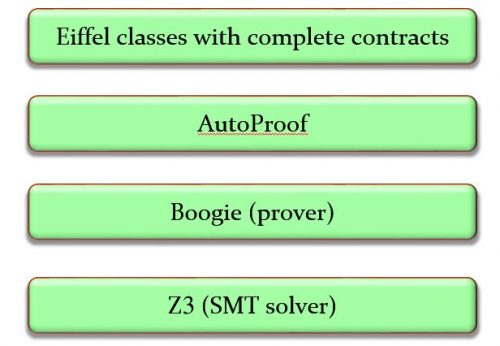
The resulting “two-step verification”, integrated into the AutoProof verification tool for Eiffel, should turn out to be an important simplification towards the goal of “Verification As a Matter Of Course” [2].

References

[1] Julian Tschannen, Carlo A. Furia, Martin Nordio and Bertrand Meyer: Program Checking With Less Hassle, in VSTTE 2013, Springer LNCS, to appear, draft available here; presentation on May 17 in the 15:30-16:30  session.

[2] Verification As a Matter Of Course, article in this blog, 29 March 2010, see here.

VN:F [1.9.10_1130]
Rating: 10.0/10 (4 votes cast)
VN:F [1.9.10_1130]
Rating: +1 (from 1 vote)

Presentations at ICSE and VSTTE


The following presentations from our ETH group in the ICSE week (International Conference on Software Engineering, San Francisco) address important issues of software specification and verification, describing new techniques that we have recently developed as part of our work building EVE, the Eiffel Verification Environment. One is at ICSE proper and the other at VSTTE (Verified Software: Tools, Theories, Experiments). If you are around please attend them.

Julian Tschannen will present Program Checking With Less Hassle, written with Carlo A. Furia, Martin Nordio and me, at VSTTE on May 17 in the 15:30-16:30 session (see here in the VSTTE program. The draft is available here. I will write a blog article about this work in the coming days.

Nadia Polikarpova will present What Good Are Strong Specifications?, written with , Carlo A. Furia, Yu Pei, Yi Wei and me at ICSE on May 22 in the 13:30-15:30 session (see here in the ICSE program). The draft is available here. I wrote about this paper in an earlier post: see here. It describes the systematic application of theory-based modeling to the full specification and verification of advanced software.

VN:F [1.9.10_1130]
Rating: 0.0/10 (0 votes cast)
VN:F [1.9.10_1130]
Rating: 0 (from 0 votes)

What is wrong with CMMI


The CMMI model of process planning and assessment has been very successful in some industry circles, essentially as a way for software suppliers to establish credibility. It is far, however, from having achieved the influence it deserves. It is, for example, not widely taught in universities, which in turn limits its attractiveness to industry. The most tempting explanation involves the substance of CMMI: that it prescribes processes that are too heavy. But in fact the basic ideas are elegant, they are not so complicated, and they have been shown to be compatible with flexible approaches to development, such as agile methods.

I think there is a simpler reason, of form rather than substance: the CMMI defining documents are atrociously written.  Had they benefited from well-known techniques of effective technical writing, the approach would have been adopted much more widely. The obstacles to comprehension discourage many people and companies which could benefit from CMMI.

Defining the concepts

One of the first qualities you expect from a technical text is that it defines the basic notions. Take one of the important concepts of CMMI, “process area”. Not just important, but fundamental; you cannot understand anything about CMMI if you do not understand what a process area is. The glossary of the basic document ([1], page 449) defines it as

A cluster of related practices in an area that, when implemented collectively, satisfies a set of goals considered important for making improvement in that area.

The mangled syntax is not a good omen: contrary to what the sentence states, it is not the area that should be “implemented collectively”, but the practices. Let us ignore it and try to understand the intended definition. A process area is a collection of practices? A bit strange, but could make sense, provided the notion of “practice” is itself well defined. Before we look at that, we note that these are practices “in an area”. An area of what? Presumably, a process area, since no other kind of area is ever mentioned, and CMMI is about processes. But then a process area is… a collection of practices in a process area? Completely circular! (Not recursive: a meaningful recursive definition is one that defines simple cases directly and builds complex cases from them. A circular definition defines nothing.)

All that this is apparently saying is that if we already know what a process area is, CMMI adds the concept that a process area is characterized by a set of associated practices. This is actually a useful idea, but it does not give us a definition.

Let’s try to see if the definition of “practice” helps. The term itself does not have an entry in the glossary, a bit regrettable but not too worrying given that in CMMI there are two relevant kinds of practices: specific and generic. “Specific practice” is defined (page 461) as

An expected model component that is considered important in achieving the associated specific goal. (See also “process area” and “specific goal.”)

This statement introduces the important observation that in CMMI a practice is always related to a “goal” (another one of the key CMMI concepts); it is one of the ways to achieve that goal. But this is not a definition of “practice”! As to the phrase “an expected model component”, it simply tells us that practices, along with goals, are among the components of CMMI (“the model”), but that is a side remark, not a definition: we cannot define “practice” as meaning “model component”.

What is happening here is that the glossary does not give a definition at all; it simply relies on the ordinary English meaning of “practice”. Realizing this also helps us understand the definition of “process area”: it too is not a definition, but assumes that the reader already understands the words “process” and “area” from their ordinary meanings. It simply tells us that in CMMI a process area has a set of associated practices. But that is not what a glossary is for: the reader expects it to give precise definitions of the technical terms used in the document.

This misuse of the glossary is typical of what makes CMMI documents so ineffective. In technical discourse it is common to hijack words from ordinary language and give them a special meaning: the mathematical use of such words as “matrix” or “edge” (of a graph) denotes well-defined objects. But you have to explain such technical terms precisely, and be clear at each step whether you are using the plain-language meaning or the technical meaning. If you mix them up, you completely confuse the reader.

In fact any decent glossary should make the distinction explicit by underlining, in definitions, terms that have their own entries (as in: a cluster or related practices, assuming there is an entry for “practice”); then it is clear to the reader whether a word is used in its ordinary or technical sense. In an electronic version the underlined words can be links to the corresponding entries. It is hard to understand why the CMMI documents do not use this widely accepted convention.

Towards suitable definitions

Let us try our hand at what suitable definitions could have been for the two concepts just described; not a vacuous exercise since process area and practice are among the five or six core concepts of CMMI. (Candidates for the others are process, goal, institutionalization and assessment).

“Practice” is the more elementary concept. In fact it retains its essential meaning from ordinary language, but in the CMMI context a practice is related to a process and, as noted, is intended to satisfy a goal. What distinguishes a practice from a mere activity is that the practice is codified and repeatable. If a project occasionally decides to conduct a  design review that is not a practice; a systematically observed daily Scrum meeting is a practice. Here is my take on defining “practice” in CMMI:

Practice: A process-related activity, repeatable as part of a plan, that helps achieve a stated goal.

CMMI has both generic practices, applicable to the process as a whole, and specific practices, applicable to a particular process area. From this definition we can easily derive definitions for both variants.

Now for “process area”. In discussing this concept above, there is one point I did not mention: the reason the CMMI documents can get away with the bizarre definition (or rather non-definition) cited is that if you ask what a process area really is you will immediately be given examples: configuration management, project planning, risk management, supplier agreement management… Then  you get it. But examples are not a substitute for a definition, at least in a standard that is supposed to be precise and complete. Here is my attempt:

Process area: An important aspect of the process, characterized by a clearly identified set of issues and activities, and in CMMI by a set of applicable practices.

The definition of “specific practice” follows simply: a practice that is associated with a particular process area. Similarly, a “generic practice” is a practice not associated with any process area.

I’ll let you be the judge: which definitions do you prefer, these or the ones in the CMMI documents?

By the way, I can hear the cynical explanation: that the jargon and obscurity are intentional, the goal being to justify the need for experts that will interpret the sacred texts. Similar observations have been made to explain the complexity of certain programming languages. Maybe. But bad writing is common enough that we do not need to invoke a conspiracy in this case.

Training for the world championship of muddy writing

The absence of clear definitions of basic concepts is inexcusable. But the entire documents are written in government-committee-speak that erect barriers against comprehension. As an example among hundreds, take the following extract, the entire description of the generic practice GP2.2, “Establish and maintain the plan for performing the organizational training process“” , part of the Software CMM (a 729-page document!), [2], page 360:

This plan for performing the organizational training process differs from the tactical plan for organizational training described in a specific practice in this process area. The plan called for in this generic practice would address the comprehensive planning for all of the specific practices in this process area, from the establishment of strategic training needs all the way through to the assessment of the effectiveness of the organizational training effort. In contrast, the organizational training tactical plan called for in the specific practice would address the periodic planning for the delivery of individual training offerings.

Even to a good-willed reader the second and third sentences sound like gibberish. One can vaguely intuit that the practice just introduced is being distinguished from another, but which one, and how? Why the conditional phrases, “would address”? A plan either does or does not address its goals. And if it addresses them, what does it mean that a plan addresses a planning? Such tortured tautologies, in a high-school essay, would result in a firm request to clean up and resubmit.

In fact the text is trying to say something simple, which should have been expressed like this:

This practice is distinct from practice SP1.3, “Establish an Organizational Training Tactical Plan” (page 353). The present practice is strategic: it is covers planning the overall training process. SP1.3 is tactical: it covers the periodic planning of individual training activities.

(In the second sentence we could retain “from defining training needs all the way to assessing the effectiveness of training”, simplified of course from the corresponding phrase in the original, although I do not think it adds much.)

Again, which version do you prefer?

The first step in producing something decent was not even a matter of style but simple courtesy to the reader. The text compares a practice to another, but it is hard to find the target of the comparison: it is identified as the “tactical plan for organizational training” but that phrase does not appear anywhere else in the document!  You have to guess that it is listed elsewhere as the “organizational training tactical plan”, search for that string, and cycle through its 14 occurrences to see which one is the definition.  (To make things worse, the phrase “training tactical plan” also appears in the document — not very smart for what is supposed to be a precisely written standard.)

The right thing to do is to use the precise name, here SP1.3 — what good is it to introduce such code names throughout a document if it does not use them for reference? — and for good measure list the page number, since this is so easy to do with text processing tools.

In the CMMI chapter of my book Touch of Class (yes, an introductory programming textbook does contain an introduction to CMMI) I cited another extract from [2] (page 326):

The plan for performing the organizational process focus process, which is often called “the process-improvement plan,” differs from the process action plans described in specific practices in this process area. The plan called for in this generic practice addresses the comprehensive planning for all of the specific practices in this process area, from the establishment of organizational process needs all the way through to the incorporation of process-related experiences into the organizational process assets.

In this case the translation into text understandable by common mortals is left as an exercise for the reader.

With such uncanny ability to say in fifty words what would better be expressed in ten, it is not surprising that basic documents run into 729 pages and that understanding of CMMI by companies who feel compelled  to adopt it requires an entire industry of commentators of the sacred word.

Well-defined concepts have simple names

The very name of the approach, “Capability Maturity Model Integration”, is already a sign of WMD (Word-Muddying Disease) at the terminal stages. I am not sure if anyone anywhere knows how to parse it correctly: is it the integration of a model of maturity of capability (right-associative interpretation)? Of several models? These and other variants do not make much sense, if only because in CMMI “capability” and “maturity” are alternatives, used respectively for the Continuous and Staged versions.

In fact the only word that seems really useful is “model”; the piling up of tetrasyllabic words with very broad meanings does not help suggest what the whole thing is about. “Integration”, for example, only makes sense if you are aware of the history of CMMI, which generalized the single CMM model to a family of models, but this history is hardly interesting to a newcomer. A name, especially a long one, should carry the basic notion.

A much better name would have been “Catalog of Assessable Process Practices”, which is even pronounceable as an acronym, and defines the key elements: the approach is based on recognized best practices; these practices apply to processes (of an organization); they must be subject to assessment (the most visible part of CMMI — the famous five levels — although not necessarily the most important one); and they are collected into a catalog. If “catalog” is felt too lowly, “collection” would also do.

Catalog of Assessable Process Practices: granted, it sounds less impressive than the accumulation of pretentious words making up the actual acronym. As is often the case in software engineering methods and tools, once you remove the hype you may be disappointed at first (“So that’s all that it was after all!”), and then you realize that the idea, although brought back down to more modest size, remains a good idea, and can be put to effective use.

At least if you explain it in English.

References

[1] CMMI Product Team: CMMI for Development, Version 1.3, Improving processes for developing better products and services, Technical Report CMU/SEI-2010-TR-033, Software Engineering Institute, Carnegie Mellon University, November 2010, available here.

[2] CMMI Product Team, ; CMMI for Systems Engineering/Software Engineering/Integrated Product and Process Development/Supplier Sourcing, Version 1.1, Staged Representation (CMMI-SE/SW/IPPD/SS, V1.1, Staged) (CMU/SEI-2002-TR-012). Software Engineering Institute, Carnegie Mellon University, 2002, available here.

VN:F [1.9.10_1130]
Rating: 9.6/10 (12 votes cast)
VN:F [1.9.10_1130]
Rating: +11 (from 11 votes)

Ershov lecture


On April 11 I gave the “Ershov lecture” in Novosibirsk. I talked about concurrency; a video recording is available here.

The lecture is given annually in memory of Andrey P. Ershov, one of the founding fathers of Russian computer science and originator of many important concepts such as partial evaluation. According to Wikipedia, Knuth considers Ershov to be the inventor of hashing. I was fortunate to make Ershov’s acquaintance in the late seventies and to meet him regularly afterwards. He invited me to his institute in Novosibirsk for a two-month stay where I learned a lot. He had a warm, caring personality, and set many young computer scientists in their tracks. His premature death in 1988 was a shock to all and his memory continues to be revered; it was gratifying to be able to give the lecture named in his honor.

VN:F [1.9.10_1130]
Rating: 10.0/10 (3 votes cast)
VN:F [1.9.10_1130]
Rating: +1 (from 1 vote)

Bringing C code to the modern world

The C2Eif translator developed by Marco Trudel takes C code and translates it into Eiffel; it produces not just a literal translation but a re-engineering version exhibiting object-oriented properties. Trudel defended his PhD thesis last Friday at ETH (the examiners were Hausi Muller from Victoria University, Manuel Oriol from ABB, Richard Paige from the University of York,  and me as the advisor). The thesis is not yet available online but earlier papers describing C2Eif are, all reachable from the project’s home page [1].

At issue is what we do with legacy code. “J’ai plus de souvenirs que si j’avais mille ans”, wrote Charles Baudelaire in Les Fleurs du Mal (“Spleen de Paris”). The software industry is not a thousand years old, but has accumulated even more “souvenirs” than

A heavy chest of drawers cluttered with balance-sheets,
Poems, love letters, lawsuits, romances
And heavy locks of hair wrapped in invoices
.

We are suffocating under layers of legacy code heaped up by previous generations of programmers using languages that no longer meet our scientific and engineering standards. We cannot get rid of this heritage; how do we bring it to the modern world? We need automatic tools to wrap it in contemporary code, or, better, translate it into contemporary code. The thesis and the system offer a way out through translation to a modern object-oriented language. It took courage to choose such a topic, since there have been many attempts in the past, leading to conventional wisdom consisting of two strongly established opinions:

  • Plain translation: it has been tried, and it works. Not interesting for a thesis.
  • Object-oriented reengineering: it has been tried, and it does not work. Not realistic for a thesis.

Both are wrong. For translation, many of the proposed solutions “almost work”: they are good enough to translate simple programs, or even some large programs but on the condition that the code avoids murky areas of C programming such as signals, exceptions (setjmp/longjmp) and library mechanisms. In practice, however, most useful C programs need these facilities, so any tool that ignores them is bound to be of conceptual value only. The basis for Trudel’s work has been to tackle C to OO translation “beyond the easy stuff” (as stated in the title of one of the published papers). This effort has been largely successful, as demonstrated by the translation of close to a million lines of actual C code, including some well-known and representative tools such as the Vim editor.

As to OO reengineering, C2Eif makes a serious effort to derive code that exhibits a true object-oriented design and hence resembles, in its structure at least, what a programmer in the target language might produce. The key is to identify the right data abstractions, yielding classes, and specialization properties, yielding inheritance. In this area too, many people have tried to come up with solutions, with little success. Trudel has had the good sense of avoiding grandiose goals and sticking to a number of heuristics that work, such as looking at the signatures of a set of functions to see if they all involve a common argument type. Clearly there is more to be done in this direction but the result is already significant.

Since Eiffel has a sophisticated C interface it is also possible to wrap existing code; some tools are available for that purpose, such as Andreas Leitner’s EWG (Eiffel Wrapper Generator). Wrapping and translating each have their advantages and limitations; wrapping may be more appropriate for C libraries that someone else is still actively updating  (so that you do not have to redo a translation with every new release), and translation for legacy code that you want to take over and bring up to par with the rest of your software. C2Eif is engineered to support both. More generally, this is a practitioner’s tool, devoting considerable attention to the many details that make all the difference between a nice idea and a tool that really works. The emphasis is on full automation, although more parametrization has been added in recent months.

C2Eif will make a big mark on the Eiffel developer community. Try it yourself — and don’t be shy about telling its author about the future directions in which you think the tool should evolve.

Reference

[1] C2Eif project page, here.

VN:F [1.9.10_1130]
Rating: 10.0/10 (13 votes cast)
VN:F [1.9.10_1130]
Rating: +8 (from 8 votes)

The origin of “software engineering”

RecycledEveryone and her sister continues to repeat the canard that the term “software engineering” was coined on the occasion of the eponymous 1968 NATO conference. A mistake repeated in every software engineering textbook remains a mistake. Below is a note I published twenty years ago on the topic in a newsgroup discussion. I found it in an archive here, where you can read the longer exchange of which it was part.

All textbooks on software engineering that I know, and many articles in the field, claim (that is to say, repeat someone else’s claim) that the term “software engineering” itself was coined on the occasion of the Fall 1968 Garmisch-Partenkirchen conference on S.E., organized by the NATO Science Affairs committee. (See [1] for the proceedings, published several years later.)

The very term, it is said, was a challenge to the software community to get its act together and start rationalizing the software production process.

This common wisdom may need to be revised. The August, 1966 issue of Communications of the ACM (Volume 9, number 8) contains an interesting “letter to the ACM membership” by Anthony A. Oettinger, then ACM President. I must confess I don’t know much about the author; he is identified (in the announcement of his election in the June 1966 issue) as Professor of Applied Mathematics and Linguistics, Harvard University, and from his picture looks like a nice fellow. The sentence of interest appears on page 546 at the end of a long paragraph, which I have reproduced below in its entirety because by looking at the full context it appears clearly that Professor Oettinger did not just use two words together by accident, as it were, but knew exactly what he was talking about. Here is the paragraph (italics in original):

“A concern with the science of computing and information processing, while undeniably of the utmost importance and an historic root of our organization [i.e. the ACM - BM] is, alone, too exclusive. While much of what we do is or has its root in not only computer and information science, but also many older and better defined sciences, even more is not at all scientific but of a professional and engineering nature. We must recognize ourselves – not necessarily all of us and not necessarily any one of us all the time – as members of an engineering profession, be it hardware engineering or software engineering, a profession without artificial and irrelevant boundaries like that between ‘scientific’ and ‘business’ applications.”

(The last point would still be worth making today. The end of the second sentence would seem to indicate that the writer viewed engineering as being remote from science, but this would not be accurate; in the paragraph following the one reproduced above, Prof. Oettinger discussed in more detail his view of the close relation between science and engineering.)

The above quotation is clear evidence that the term “software engineering” was used significantly earlier than commonly thought – more than two years before the Garmisch conference.

What I don’t know is whether Prof. Oettinger created the term, or whether it had been in use before. In the latter case, does anyone know of an older reference? Is Prof. Oettinger still around to enlighten us? (For all I know he could be reading this!)

Switching now our theme from the past to the future: does anyone have an idea of when some actual semantics might become attached to the expression “software engineering”? Is 2025 too optimistic?

Reference

[1] J. M. Buxton, P. Naur, B. Randell: Software Engineering Concepts and Techniques (Proceeedings of 1968 NATO Conference on Software Engineering), Van Nostrand Reinhold, 1976.

The last sentence’s sarcasm is, by the way, no longer warranted today.

VN:F [1.9.10_1130]
Rating: 8.2/10 (5 votes cast)
VN:F [1.9.10_1130]
Rating: +1 (from 1 vote)

LASER summer school: Software for the Cloud and Big Data

The 2013 LASER summer school, organized by our chair at ETH, will take place September 8-14, once more in the idyllic setting of the Hotel del Golfo in Procchio, on the island of Elba in Italy. This is already the 10th conference; the roster of speakers so far reads like a who’s who of software engineering.

The theme this year is Software for the Cloud and Big Data and the speakers are Roger Barga from Microsoft, Karin Breitman from EMC,  Sebastian Burckhardt  from Microsoft,  Adrian Cockcroft from Netflix,  Carlo Ghezzi from Politecnico di Milano,  Anthony Joseph from Berkeley,  Pere Mato Vila from CERN and I.

LASER always has a strong practical bent, but this year it is particularly pronounced as you can see from the list of speakers and their affiliations. The topic is particularly timely: exploring the software aspects of game-changing developments currently redefining the IT scene.

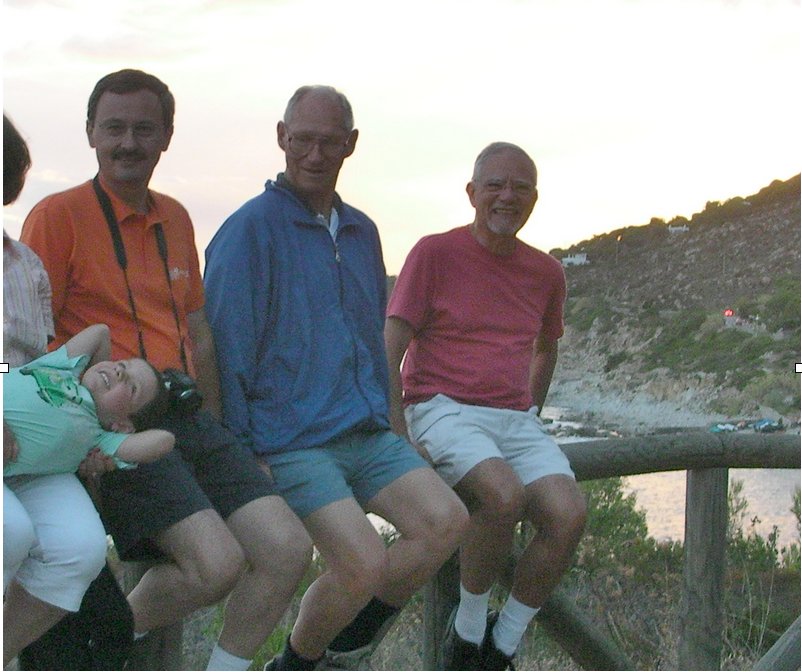
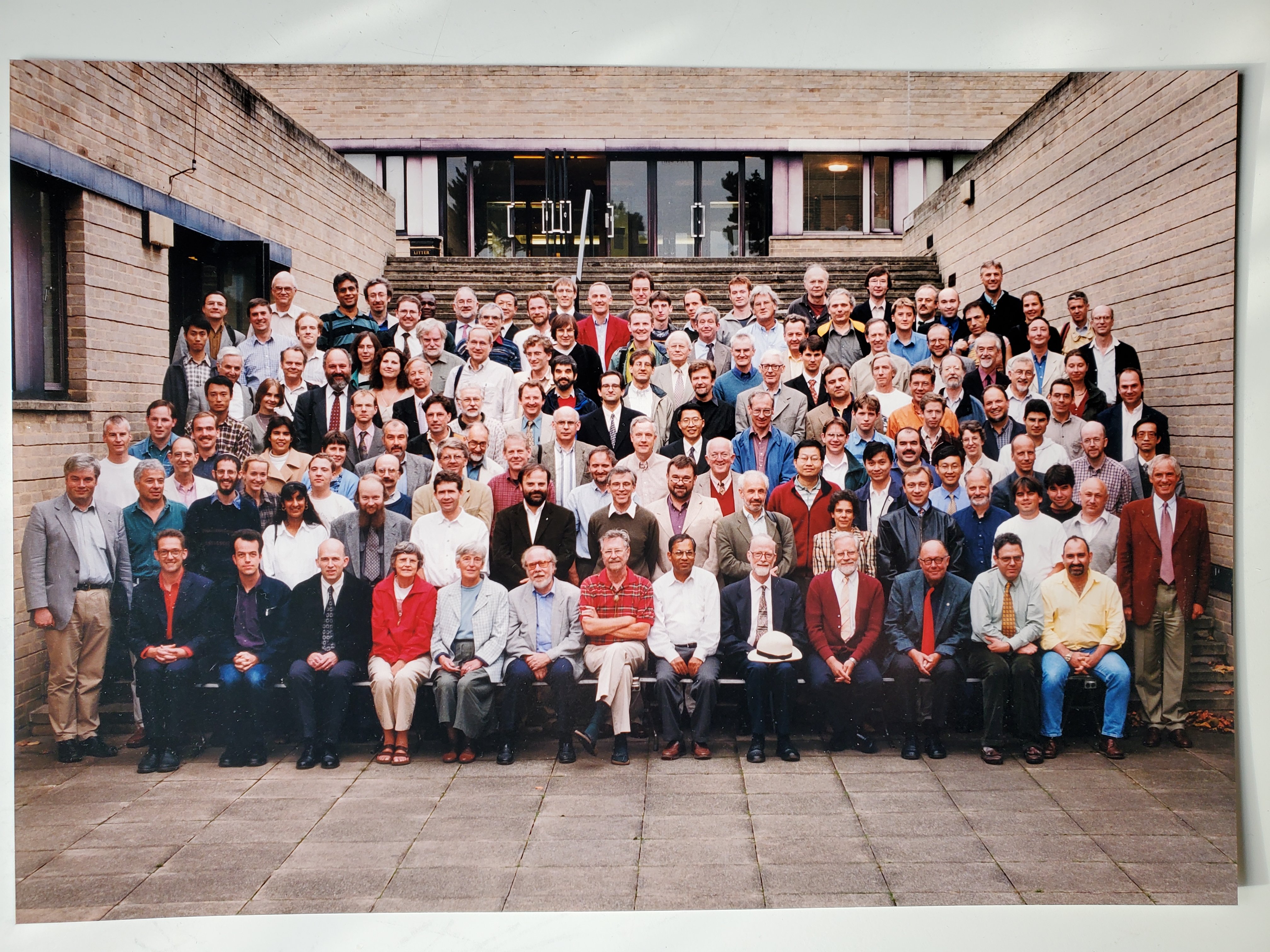
The LASER formula is by now well-tuned: lectures over seven days (Sunday to Saturday), about five hours in the morning and three in the early evening, by world-class speakers; free time in the afternoon to enjoy the magnificent surroundings; 5-star accommodation and food in the best hotel of Elba, made affordable as we come towards the end of the season (and are valued long-term customers). The group picture below is from last year’s school.

Participants are from both industry and academia and have ample opportunities for interaction with the speakers, who typically attend each others’ lectures and engage in in-depth discussions. There is also time for some participant presentations; a free afternoon to discover Elba and brush up on your Napoleonic knowledge; and a boat trip on the final day.

Information about the 2013 school can be found here.

LASER 2012, Procchio, Hotel del Golvo

VN:F [1.9.10_1130]
Rating: 0.0/10 (0 votes cast)
VN:F [1.9.10_1130]
Rating: 0 (from 0 votes)

The ABC of software engineering

Lack of a precise context can render discussions of software engineering and particularly of software quality meaningless. Take for example the (usually absurd) statement “We cannot expect that programmers will equip their programs with contracts”. Whom do you mean? A physicist who writes 50 lines of Matlab code to produce a graph illustrating his latest experiment? A member of the maintenance team for Microsoft Word? A programmer on the team for a flight control system? These are completely different constituencies, and the answer is also different. In the last case, the answer is probably that we do not care what the programmers like and do not like. When you buy an electrical device that malfunctions, would you accept from the manufacturer the excuse that differential equations are, really, you see, too hard for our electrical engineers?

In discussing the evolution of software methods and tools we must first specify what and whom we are talking about. The following ABC characterization is sufficient for most cases.

C is for Casual. Programs in that category do all kinds of useful things, and like anything else they should work properly, but if they are not ideal in software engineering terms of reliability, reusability, extendibility and so on — if sometimes they crash, sometimes produce not-quite-right results,  cannot be easily understood or maintained by anyone other than their original developers, target just one platform, run too slowly, eat up too much memory, are not easy to change, include duplicated code — it is not the end of the world. I do not have any scientific figures, but I suspect that most of the world’s software is actually in that category, from JavaScript or Python code that runs web sites to spreadsheet macros. Obviously it has to be good enough to serve its needs, but “good enough” is good enough.

B is for Business. Programs in that category run key processes in the organization. While often far from impeccable, they must satisfy strict quality constraints; if they do not, the organization will suffer significantly.

A is for Acute. This is life-critical software: if it does not work — more precisely, if it does not work exactly right — someone will get killed, someone will lose huge amounts of money, or something else will go terribly wrong. We are talking transportation systems, software embedded in critical devices, make-or-break processes of an organization.

Even in a professional setting, and even within a single company, the three categories usually coexist. Take for example a large engineering or scientific organization.  Some programs are developed to support experiments or provide an answer to a specific technical question. Some programs run the organization, both on the information systems side (enterprise management) and on the technical side (large scientific simulations, experiment set-up). And some programs play a critical role in making strategy decisions, or run the organization’s products.

The ABC classification is independent of the traditional division between enterprise and technical computing. Organizations often handle these two categories separately, whereas in fact they raise issues of similar difficulty and are subject to solutions of a similar nature. It is more important to assess the criticality of each software projects, along the ABC scale.

It is surprising that few organizations make that scale explicit.  It is partly a consequence of that neglect that many software quality initiatives and company-wide software engineering policies are ineffective: they lump everything together, and since they tend to be driven by A-grade applications, for which the risk of bad quality is highest, they create a burden that can be too high for C- and even B-grade developments. People resent the constraints where they are not justified, and as a consequence ignore them where they would be critical. Whether your goal for the most demanding projects is to achieve CMMI qualification or to establish an effective agile process, you cannot impose the same rules on everyone. Sometimes the stakes are high; and sometimes a program is just a program.

The first step in establishing a successful software policy is to separate levels of criticality, and require every development to position itself along the resulting scale. The same observation qualifies just about any discussion of software methodology. Acute, Business or Casual: you must know your ABC.

VN:F [1.9.10_1130]
Rating: 10.0/10 (9 votes cast)
VN:F [1.9.10_1130]
Rating: +9 (from 9 votes)

Apocalypse no! (part 1)


Recycled(Originally published in the CACM blog. Part 1 of a two-part article. See [2] for part 2.)

On a cold morning of February 2012, Mr. S woke up early. Even though his sleep was always deep, he did not resent having to interrupt it since he had set up his iPhone’s alarm to a favorite tune from Götterdämmerung, downloaded from a free-MP3 site. He liked his breakfast eggs made in a very specific way, and got them exactly right since he had programmed his microwave oven to the exact combination of heat and cooking time.

He had left his car to his daughter on the previous night; even though the roads were icy, he did not worry too much for her, since he knew the automatic braking system was good at silently correcting the mistakes of a still somewhat novice driver; and with the car’s built-in navigation system she would be advised away from any impracticable street.

As for himself he decided to take public transportation, something he did only rarely. He had forgotten the schedule, but found it on the Web and saw that he had a few minutes before the next bus. The extra time meant that he could quickly check his email. He noticed that he had received, as a PDF attachment, the pay slip for his last consulting gig; as an Agile consultant, Mr. S was in high demand. He knew his accountant’s system would automatically receive and check the information, but still made a cursory pass to convince himself that the figures looked right, with social security contributions and tax deductions properly computed.

He went out and hopped onto the bus, all the way to the client’s office continuing to check his email on his phone, even finding the time to confirm the online flight reservation for his next consulting assignment, while monitoring the hanging displays to check the bus’s progress (it was all dark outside and he was not that familiar with the route). Unlike some mornings, he had remembered to take his id card, so he was able to slide it into the slot at the building’s entrance and again into the elevator, gaining access to the right floor. Before heading to his office he walked to the beverage machine for his morning coffee, a particular but programmable combination of two-shot expresso, a bit of hot water, and just a touch of milk.

Sitting down at his computer, he brought it up from hibernation, for some reason remembering — Mr. S was fond of such trivia — that Windows 7 was estimated to consist of 50 million lines of code, and reflecting that the system now kind of did what he wanted from it. Mr. S had thought of moving, like many of his friends, to a Mac, but the advantages were not clear, and he was fond of the old Word text processing system with which he was writing his latest agile advocacy text, tentatively entitled Software in 30 days. (It has since appeared as a book [1].)

Mr. S — whose full name was either “Schwaber” or “Sutherland”, although it might have been “Scrum” or perhaps “Sprint”, as some of the details of the story are missing — opened up the document at the place where he had left it the evening before. Like many a good author, he had postponed finalizing the introduction to the last moment. Until now inspiration had failed him and his coauthor: it is always so hard to discover how best to begin! Over the past months, working together in long Skype discussions from wherever each happened to be, they had tried many different variants, often simultaneously editing their shared Google Docs draft. But now he suddenly knew exactly what he had to say to capture the future readers’ attention.

The sentence, which was to remain as the key punch delivered by the first page of the published book [1, page 1], sprung to his mind in one single, felicitous shot:

You have been ill served by the software industry for 40 years — not purposefully, but inextricably.

References

[1] Ken Schwaber and Jeff Sutherland: Software in 30 Days — How Agile Managers Beat the Odds, Delight their Customers and Leave Competitors in the Dust, Wiley, 2012.
[2] Part 2 of the present article was published on 16 May 2013 and appears here.

VN:F [1.9.10_1130]
Rating: 10.0/10 (7 votes cast)
VN:F [1.9.10_1130]
Rating: +2 (from 4 votes)

Public lecture at ITMO

I am giving my “inaugural lecture” at ITMO in Saint Petersburg tomorrow (Thursday, 28 February 2013) at 14 (2 PM) local time, meaning e.g. 11 AM in Western Europe and 2 AM (ouch!) in California. See here for the announcement. The title is “Programming: Magic, Art, Routine or Science?“. The talk will be streamed live: see here.

VN:F [1.9.10_1130]
Rating: 10.0/10 (1 vote cast)
VN:F [1.9.10_1130]
Rating: +1 (from 1 vote)

Doing it right or doing it over?

(Adapted from an article in the Communications of the ACM blog.)

I have become interested in agile methods because they are all the rage now in industry and, upon dispassionate examination, they appear to be a pretty amazing mix of good and bad ideas. I am finishing a book that tries to sort out the nuggets from the gravel [1].

An interesting example is the emphasis on developing a system by successive increments covering expanding slices of user functionality. This urge to deliver something that can actually be shown — “Are we shipping yet?” — is excellent. It is effective in focusing the work of a team, especially once the foundations of the software have been laid. But does it have to be the only way of working? Does it have to exclude the time-honored engineering practice of building the infrastructure first? After all, when a building gets constructed, it takes many months before any  “user functionality” becomes visible.

In a typical exhortation [2], the Poppendiecks argue that:

The right the first time approach may work for well-structured problems, but the try-it, test-it, fix-it approach is usually the better approach for ill-structured problems.

Very strange. It is precisely ill-structured problems that require deeper analysis before you jump in into wrong architectural decisions which may require complete rework later on. Doing prototypes to try possible solutions can be a great way to evaluate potential solutions, but a prototype is an experiment, something quite different from an increment (an early version of the future system).

One of the problems with the agile literature is that its enthusiastic admonitions to renounce standard software engineering practices are largely based on triumphant anecdotes of successful projects. I am willing to believe all these anecdotes, but they are only anecdotes. In the present case systematic empirical evidence does not seem to support the agile view. Boehm and Turner [3] write:

Experience to date indicates that low-cost refactoring cannot be depended upon as projects scale up.

and

The only sources of empirical data we have encountered come from less-expert early adopters who found that even for small applications the percentage of refactoring and defect-correction effort increases with [the size of requirements].

They do not cite references here, and I am not aware of any empirical study that definitely answers the question. But their argument certainly fits my experience. In software as in engineering of any kind, experimenting with various solutions is good, but it is critical to engage in the appropriate Big Upfront Thinking to avoid starting out with the wrong decisions. Some of the worst project catastrophes I have seen were those in which the customer or manager was demanding to see something that worked right away — “it doesn’t matter if it’s not the whole thing, just demonstrate a piece of it! — and criticized the developers who worked on infrastructure that did not produce immediately visible results (in other words, were doing their job of responsible software professionals). The inevitable result: feel-good demos throughout the project, reassured customer, and nothing to deliver at the end because the difficult problems have been left to rot. System shelved and never to be heard of again.

When the basis has been devised right, perhaps with nothing much to show for months, then it becomes critical to insist on regular visible releases. Doing it prematurely is just sloppy engineering.

The problem here is extremism. Software engineering is a difficult balance between conflicting criteria. The agile literature’s criticism of teams that spend all their time on design or on foundations and never deliver any usable functionality is unfortunately justified. It does not mean that we have to fall into the other extreme and discard upfront thinking.

In the agile tradition of argument by anecdote, here is an extract from James Surowiecki’s  “Financial Page” article in last month’s New Yorker. It’s not about software but about the current Boeing 787 “Dreamliner” debacle:

Determined to get the Dreamliners to customers quickly, Boeing built many of them while still waiting for the Federal Aviation Administration to certify the plane to fly; then it had to go back and retrofit the planes in line with the FAA’s requirements. “If the saying is check twice and build once, this was more like build twice and check once”, [an industry analyst] said to me. “With all the time and cost pressures, it was an alchemist’s recipe for trouble.”

(Actually, the result is “build twice and check twice”, or more, since every time you rebuild you must also recheck.) Does that ring a bell?

Erich Kästner’s ditty about reaching America, cited in a previous article [5], is once again the proper commentary here.

References

[1] Bertrand Meyer: Agile! The Good, the Hype and the Ugly, Springer, 2013, to appear.

[2] Mary and Tom Poppendieck: Lean Software Development — An Agile Toolkit, Addison-Wesley, 2003.

[3] Barry W. Boehm and Richard Turner: Balancing Agility with Discipline — A Guide for the Perplexed, Addison-Wesley, 2004. (Second citation slightly abridged.)

[4] James Surowiecki, in the New Yorker, 4 February 2013, available here.

[5] Hitting on America, article from this blog, 5 December 2012, available here.

VN:F [1.9.10_1130]
Rating: 8.9/10 (8 votes cast)
VN:F [1.9.10_1130]
Rating: +4 (from 4 votes)
Master, please explain: “recursively”


With pleasure. To define a concept recursively is to define part of it directly and the rest, if any, recursively.

VN:F [1.9.10_1130]
Rating: 8.9/10 (8 votes cast)
VN:F [1.9.10_1130]
Rating: +4 (from 4 votes)
How good are strong specifications? (New paper, ICSE 2013)


A core aspect of our verification work is the use of “strong” contracts, which express sophisticated specification properties without requiring a separate specification language: even for advanced properties, there is no need for a separate specification language, with special notations such as those of first-order logic; instead, one can continue to rely, in the tradition of Design by Contract, on the built-in notations of the programming language, Eiffel.

This is the idea of domain theory, as discussed in earlier posts on this blog, in particular [1]. An early description of the approach, part of Bernd Schoeller’s PhD thesis work, was [2]; the next step was [3], presented at VSTTE in 2010.

A new paper to be presented at ICSE in May [3], part of an effort led by Nadia Polikarpova for her own thesis in progress, shows new advances in using strong specifications, demonstrating their expressive power and submitting them to empirical evaluation. The results show in particular that strong specifications justify the extra effort; in particular they enable automatic tests to find significantly more bugs.

A byproduct of this work is to show again the complementarity between various forms of verification, including not only proofs but (particularly in the contribution of two of the co-authors, Yi Wei and Yu Pei, as well as Carlo Furia) tests.

References

[1] Bertrand Meyer: Domain Theory: the forgotten step in program verification, article on this blog, see here.

[2] Bernd Schoeller, Tobias Widmer and Bertrand Meyer: Making Specifications Complete Through Models, in Architecting Systems with Trustworthy Components, eds. Ralf Reussner, Judith Stafford and Clemens Szyperski, Lecture Notes in Computer Science, Springer-Verlag, 2006, available here.

[3] Nadia Polikarpova, Carlo Furia and Bertrand Meyer: Specifying Reusable Components, in Verified Software: Theories, Tools, Experiments (VSTTE ‘ 10), Edinburgh, UK, 16-19 August 2010, Lecture Notes in Computer Science, Springer Verlag, 2010, available here.

[4] Nadia Polikarpova, Carlo A. Furia, Yu Pei, Yi Wei and Bertrand Meyer: What Good Are Strong Specifications?, to appear in ICSE 2013 (Proceedings of 35th International Conference on Software Engineering), San Francisco, May 2013, draft available here.

VN:F [1.9.10_1130]
Rating: 10.0/10 (1 vote cast)
VN:F [1.9.10_1130]
Rating: +1 (from 1 vote)

Multirequirements (new paper)


As part of a Festschrift volume for Martin Glinz of the university of Zurich I wrote a paper [1] describing a general approach to requirements that I have been practicing and developing for a while, and presented in a couple of talks. The basic idea is to rely on object-oriented techniques, including contracts for the semantics, and to weave several levels of discourse: natural-language, formal and graphical.

Reference

[1] Bertrand Meyer: Multirequirements, to appear in Martin Glinz Festschrift, eds. Anne Koziolek and Norbert Scheyff, 2013, available here.

VN:F [1.9.10_1130]
Rating: 10.0/10 (4 votes cast)
VN:F [1.9.10_1130]
Rating: +3 (from 3 votes)

ESEC/FSE 2013: 18-26 August, Saint Petersburg, Russia

The European Software Engineering Conference takes place every two years in connection with the ACM Foundations of Software Engineering symposium (which in even years is in the US). The next ESEC/FSE  will be held for the first time in Russia, where it will be the first major international software engineering conference ever. It comes at a time when the Russian software industry is ever more present through products and services offered worldwide. See the conference site here. The main conference will be held 21-23 August 2013, with associated events before and after so that the full dates are August 18 to 26. (I am the general chair.)

Other than ICSE, ESEC/FSE is second to none in the quality of the program. We already have four outstanding keynote speakers:  Georges Gonthier from Microsoft Research, Paola Inverardi from L’Aquila in Italy, David Notkin from U. of Washington (in whose honor a symposium will be held as an associated event of ESEC/FSE, chaired by Michael Ernst), and Moshe Vardi of Rice and of course Communications of the ACM.

Saint Petersburg is one of the most beautiful cities in the world, strewn with gilded palaces, canals, world-class museums (not just the Hermitage), and everywhere mementos of the great poets, novelists, musicians and scientists who built up its fame.

Hosted by ITMO National Research University, the conference will be held in the magnificent building of the Razumovsky Palace on the banks of the Moika river; see here.

The Call for Papers has a deadline of March 1st, so there is still plenty of time to polish your best paper and send it to ESEC/FSE. There is also still time to propose worskhops and other associated events. ESEC/FSE will be a memorable moment for the community and we hope to see many of the readers there.

VN:F [1.9.10_1130]
Rating: 9.7/10 (3 votes cast)
VN:F [1.9.10_1130]
Rating: +2 (from 2 votes)

A Pretty Good Motto

Antoine Galland (1646-1715), one of the great orientalists of the classical age, was sent by the government of Louis XIV to the court of the Sultan. Among his many discoveries he revealed the Thousand and One Nights and other Arabian Tales to the Western public through his French translation, Les Mille et Unes Nuits, Paris 1704-1717. The diary from his stay in Constantinople in 1672-1673 was published and annotated by Charles Schefer in 1881 [1].

On page 133 of volume 2 I found this “litteral translation of a quatrain attributed to Saady” , presumably Abū-Muhammad Muslih al-Dīn bin Abdallāh Shīrāzī, Persian poet born in 1184 and according to Wikipedia deceased in either 1281 or 1303. I have not seen it anywhere else, and it seems like a pretty good motto [2]:

Think back to the time when you came to the world. Everyone around you was in joy, and you were crying.
Apply all your strength so that when you die, all will be in grief and you alone will smile.

Reference and note

[1] Journal d’Antoine Galland pendant son Séjour à Constantinople (1672-1673), publié et annoté par Charles Schefer (2 volumes), Ernest Leroux, Paris, 1881.

[2] My translation. Galland’s original, which also includes the Persian quote (below) reads:

Réfléchis à l’instant où tu es venu au monde. Ceux qui t’entouraient étaient dans la joie et toi tu pleurais. Fais tous tes efforts pour qu’au moment de ton trépas, tout le monde soit plongé dans la douleur et toi seul souriant.

Ces vers sont une traduction littérale d’un quatrain persan attribué à Saady.

Saady's original as cited by Galland

VN:F [1.9.10_1130]
Rating: 10.0/10 (8 votes cast)
VN:F [1.9.10_1130]
Rating: +8 (from 8 votes)

Negative variables and the essence of object-oriented programming (new paper)

In modeling object-oriented programs, for purposes of verification (proofs) or merely for a better understanding, we are faced with the unique “general relativity” property of OO programming: all the operations you write (excluding non-OO mechanisms such as static functions) are expressed relative to a “current object” which changes repeatedly execution. More precisely at the start of a call x.r (…) and for the duration of that call the current object changes to whatever x denotes — but to determine that object we must again interpret x in the context of the previous current object. This raises a challenge for reasoning about programs; for example in a routine the notation f.some_reference, if f is a formal argument, refers to objects in the context of the calling object, and we cannot apply standard rules of substitution as in the non-OO style of handling calls.

In earlier work [1, 2] initially motivated by the development of the Alias Calculus, I introduced a notion of negative variable to deal with this issue. During the execution of a call x.r (…) the negation of x , written x’, represents a back pointer to the calling object; negative variables are characterized by axiomatic properties such as x.x’= Current and x’.(old x)= Current. Alexander Kogtenkov has implemented these ideas and refined them.

Negative variable as back pointer

In a recent paper under submission [3], we review the concepts and applications of negative variables.

References

[1] Bertrand Meyer: Steps Towards a Theory and Calculus of Aliasing, in International Journal of Software and Informatics, 2011, available here.

[2] Bertrand Meyer: Towards a Calculus of Object Programs, in Patterns, Programming and Everything, Judith Bishop Festschrift, eds. Karin Breitman and Nigel Horspool, Springer-Verlag, 2012, pages 91-128, available here.

[3] Bertrand Meyer and Alexander Kogtenkov: Negative Variables and the Essence of Object-Oriented Programming, submitted for publication, 2012, draft available here.

VN:F [1.9.10_1130]
Rating: 10.0/10 (5 votes cast)
VN:F [1.9.10_1130]
Rating: +3 (from 5 votes)

The education minister who wants fewer students

Picture yourself an incoming education minister in one of the EU countries — Germany, France, UK — who declares that he would like fewer students to graduate and go to university. Imagine the clamor. Even in the US  — where the secretary of education does not in fact have much sway over high schools, managed locally, or universities, controlled by the states or by private organizations — outrage would erupt. Assume for good measure that he criticizes immigrants for pushing their children to educate themselves. Pretty unthinkable.

Johann Schneider-Ammann will be education minister of Switzerland starting in 2013. (The seeming innocuousness of this factual statement belies the uniqueness of the situation: rather than ministries in the usual sense, Switzerland has federal departments, and their management rotates among the seven Federal Counselors — as does, yearly, the presidency of the Confederation. But that topic is for another day.) In a recent interview [1], Schneider-Ammann states that it would be a grave danger to allow any further growth of the percentage of students graduating with the high-school degree, the “Maturity” or  in common parlance Matura (equivalent to the German Abitur and the French Baccalauréat). What is this scary threshold? The graduation rate (France: 84.5%) has in Switzerland grown in the past years from 12% to a whopping 20%. This is where the minister wants to raise a red flag.

Not stopping there, he bitterly complains that immigrant families “want their children to get a Matura at any price”. These immigrant’s conceit has no bound! Can you fathom the insolence: they want to educate their kids!

Were such declarations to come from Mr. Schneider-Ammann’s French counterpart, the streets of Paris would fill up with pitchfork-brandishing youngsters. In the US, no one would even understand the part about immigrants: walk the halls of Berkeley or Stanford and it’s Asians everywhere, since childhood pushed to excellence by their “Chinese mothers” [2] or equivalent.

What is going on? Has Switzerland put in charge of its education the equivalent of (in the US) the would-be Republican candidate Rick Santorum, who infamously proclaimed that “President Obama wants everybody in America to go to college. What a snob!”.

Well, to a point, yes. But Schneider-Ammann, an ETH graduate in electrical engineering, is not an obscurantist and not driven by religious extremism. What he is talking about is the uniqueness of the Swiss educational system, which includes a separation of students at the age of 12 between those who will pursue the Matura, leading to open admission to almost any university program [3], and those channeled to technical tracks with reduced teaching hours and extensive on-the-job training. That system explains the 20% figure: it is not that the other 80% are left to rot; most of them receive a job-oriented qualification and a technical degree. Anyone who has tried to use the services of a plumber in the United States and in Switzerland understands the effect of this system on the quality of professional work (and its price).

Schneider-Ammann (along with, in my experience, most education professionals in Switzerland) has no qualms about defending that system. He says:

Every society is a kind of pyramid with, at the top, the most intellectual people and those with the most predisposition to education, and a wide base made of people with essentially manual skills. We have to include these in our education system as well. This is the only way to remain competitive and innovative and keep everyone, to all the extent possible, in the employment process.

In many circles such an unabated view would be howled down as elitist and paternalistic. The Swiss, however, have little interest in the kind of abstract arguments that are popular among French and German intellectuals. They are pragmatic and look at the results. Schneider-Ammann is not shy in pointing the fingers at other countries:

The more high-shool graduates a country has, the higher its unemployment rate. The relationship is obvious when one looks at the statistics. Highfalutin education plays its part in deindustrialisation. We can see it in Great Britain or France.

The views on immigrants are in the same spirit. Think not of mathematically brilliant Asian students forcefully entering computer science at MIT, but of children of families — for example, as Schneider-Ammann  helpfully explains lest anyone fear ambiguity, “from Germany or France”— which “come to Switzerland and from the experience of their country of origin know hardly anything else than the academic road to education”. Ah, these German mothers who know “hardly anything else” than universities! These French fathers who do not wake up at night worrying whether their daughters will make it to tram driver!

These arguments will, one guesses, make for interesting conversations when he does become minister and gets to meet his foreign colleagues, but they are hard to ignore. What do the statistics actually say?

From OECD documents, e.g. [4], I do not completely understand the British picture (not much of a comment since there are few things I understand about Britain). In  France, where reaching a 80% rate of success at the Baccalauréat was a decades-old political goal and a cause for national celebration when reached a few years ago, the unemployment  is currently 9.5% and shows no sign of abating (that is an optimistic way of putting it). Significantly, high unemployment  is not a fluke resulting from the current  economic crisis but a persistent problem going back at least to the eighties and clearly resulting from structural causes. In Germany, for all its economic strength, the rate is hardly better, having oscillated between 9% and 11% between 2002 and 2007 and remaining around 7% in 2012.

In Switzerland: 3% today, and never above 4% since 2001. (In early 2001 it was around 1.6%!) As to the educational level of the population, the OECD notes [3] that  Switzerland is a top-performing OECD country in reading literacy, maths and sciences with the average student scoring 517.

Correlation is not causation; politicians simplify complex matters, and one can think of a few counter-examples to Mr. Schneider-Ammann’s reasoning (I would like to get a better idea of the Finnish picture, and Korea also seems an interesting case). Still, that reasoning has to be taken seriously. Anyone familiar with the French situation, for example, can only wonder what good it is to give everyone the Bac and access to overcrowded university tracks of sociology, ethnography and psychology. How many ethnographers does a country need? Since the world is selective, selection occurs anyway, if after the  Bac, and most notably in controlling access to the noblest part of the system — the top of Schneider-Ammann’s pyramid: the Grandes Écoles, which are unabashedly elitist. Families in the know understand that the competitive examinations to Polytechnique and the like, not the Bac, are the exams that count. This part of the system, the royal track, works very well; I had the immense privilege of benefiting from it and can testify to its efficiency. It is at least as exclusive as the Swiss Matura+University track. The problem is the rest of the system; those students who do not make it to the top are somehow herded to the Bac and the first years of ordinary universities without the appropriate support and infrastructure.

Thereby lies the difference: the Swiss have no patience for grand speeches about high education, the implicit promise that everyone can become Jean-Paul Sartre or Simone de Beauvoir, and the harsh accompanying reality of a system that hides cruel disparities behind the appearance of universal access. Instead, they bluntly sort out at a tender age [5] the few intellectuals from the many practically-oriented students. The big difference with some other countries is that the latter category is neither duped nor dumped: neither duped into believing they can have an high-flying university education, nor dumped to mend for themselves. The technical and apprenticeship programs are are seriously organized, well-funded, and intended to lead to stable, respected professions.

So far the system has worked incredibly well; the durably low unemployment rate, in sharp contrast with neighboring countries, is only one sign of the country’s success. I do not know how much of the correlation is causation, and how much the Swiss experience is transposable to other countries.

As an intellectual, and someone who gained so much from education in peerless institutions, I do not feel in a good position to decree that others should just learn a trade.  But I find the argument fascinating. The conventional wisdom today is that countries must educate, educate, educate. Usually this is understood as pushing ever more students towards academic tracks. There are a few dissenting voices; Paul Krugman, for example, has regularly warned that automation today threatens low-end intellectual jobs (he comes back to that theme in today’s New York Times [5]). I do not know the answer; but the questions are worth asking, without fear of breaking taboos.

References and notes

[1] «Ich hätte lieber etwas weniger, dafür bessere Maturanden» (I’d rather have somewhat fewer and hence better high-school graduates), interview of Johann Schneider-Ammann (in German),  by René Donzé and Sarah Nowotny, Neue Zürcher Zeitung, 28 October 2012, available here.

[2] Amy Chua, Battle Hymn of the Tiger Mother, Penguin Press, 2011, see summary here.

[3] Law and medicine have a numerus clausus. Students graduating with a Matura can otherwise enter the university and program of their choice.

[4] OECD Better Life index, here. Note that the OECD reports give Switzerland a high-school graduation rate of 90%, at the very top of countries surveyed, meaning that the rate does not distinguish between the various kinds of high-school certificates. High-school graduation rates as discussed in the present article refer to the standard academic tracks, which for Switzerland means the Matura not including professional tracks.

[5] Migration paths exist, for hard-working late bloomers who want to transition from the lower-tier system to the universities.

[6] Paul Krugman: Robots and Robber Barons, New York Times, 9 December 2012, available here.

VN:F [1.9.10_1130]
Rating: 9.8/10 (12 votes cast)
VN:F [1.9.10_1130]
Rating: +6 (from 8 votes)

Hitting on America


The study of agile methods is good for your skeptical bones.

“Build the simplest thing that works, then refactor if needed.”

Maybe. Maybe. But what about getting it right the first time around?

Erich Kästner wrote an apposite ditty on this topic [1]:

They tell you it’s OK if first you fail;
OK perhaps — but not so practical.
Not all who for India set sail
Hit on America.

Note

[1] My translation. The original reads:

Irrtümer haben ihren Wert;
Jedoch noch hie und da.
Nicht jeder, der nach Indien fährt,
Endeckt Amerika.

VN:F [1.9.10_1130]
Rating: 5.5/10 (6 votes cast)
VN:F [1.9.10_1130]
Rating: +1 (from 7 votes)

Loop invariants: the musical


Actually it is not a musical but an extensive survey. I have long been fascinated by the notion of loop invariant, which describes the essence of a loop. Considering a loop without its invariant is like conducting an orchestra without a score.

In this submitted survey paper written with Sergey Velder and Carlo Furia [1], we study loop invariants in depth and describe many algorithms from diverse areas of computer science through their invariants. For simplicity and clarity, the specification technique uses the Domain Theory technique described in an earlier article on this blog [2] (see also [3]). The invariants were verified mechanically using Boogie, a sign of how much more realistic verification technology has become in recent years.

The survey was a major effort (we worked on it for a year and a half); it is not perfect but we hope it will prove useful in the understanding, teaching and verification of important algorithms.

Here is the article’s abstract:

At the heart of every loop, and hence of all significant algorithms, lies a loop invariant: a property ensured by the initialization and maintained by every iteration so that, when combined with the exit condition, it yields the loop’s final effect. Identifying the invariant of every loop is not only a required step for software verification, but also a key requirement for understanding the loop and the program to which it belongs. The systematic study of loop invariants of important algorithms can, as a consequence, yield insights into the nature of software.

We performed this study over a wide range of fundamental algorithms from diverse areas of computer science. We analyze the patterns according to which invariants are derived from postconditions, propose a classification of invariants according to these patterns, and present its application to the algorithms reviewed. The discussion also shows the need for high-level specification and invariants based on “domain theory”. The
included invariants and the corresponding algorithms have been mechanically verified using an automatic program prover. Along with the classification and applications, the conclusions include suggestions for automatic invariant inference and general techniques for model-based specification.


References

[1] Carlo Furia, Bertrand Meyer and Sergey Velder: Loop invariants: analysis, classification, and examples, submitted for publication, December 2012, draft available here.

[2] Domain Theory: the Forgotten Step in Program Verification, article from this blog, 11 April 2012, available here.

[3] Domain Theory: Precedents, article from this blog, 11 April 2012, available here

VN:F [1.9.10_1130]
Rating: 9.8/10 (4 votes cast)
VN:F [1.9.10_1130]
Rating: +2 (from 2 votes)

Publication list


I have updated my publication list [1] to include recently published and accepted papers, and some ongoing work. Most of the papers are collaborative, reflecting the work of our ETH and ITMO groups on verification, concurrency and methodology.


Reference

[1] Publication list, available here (in various formats).

VN:F [1.9.10_1130]
Rating: 10.0/10 (4 votes cast)
VN:F [1.9.10_1130]
Rating: +2 (from 2 votes)

Why so many features?


It is a frequent complaint that production software contains too many features: “I use only  maybe 5% of Microsoft Word!” , with the implication that the other 95% are useless, and apparently without the consideration that maybe someone else needs them; how do you know that what is good enough for you is good enough for everyone?

The agile literature frequently makes this complaint against “software bloat“, and has turned it into a principle: build minimal software.

Is software really bloated? Rather than trying to answer this question it is useful to analyze where features come from. In my experience there are three sources: internal ideas; suggestions from the field; needs of key customers.

1. Internal ideas

A software system is always devised by a person or group, who have their own views of what it should offer. Many of the more interesting features come from these inventors and developers, not from the market. A competent group does not wait for users or prospects to propose features, but comes up with its own suggestions all the time.

This is usually the source of the most innovative ideas. Major breakthroughs do not arise from collecting customer wishes but from imagining a new product that starts from a new basis and proposing it to the market without waiting for the market to request it.

2. Suggestions from the field

Customers’ and prospects’ wishes do have a crucial role, especially for improvements to an existing product. A good marketing department will serve as the relay between the field’s wishes and the development team. Many such suggestions are of the “Check that box!” kind: customers and particularly prospects look at the competition and want to make sure that your product does everything that the others do. These suggestions push towards me-too features; they are necessary to keep up with the times, but must be balanced with suggestions from the other two sources, since if they were the only inspiration they would lead to a product that has the same functionality as everyone else’s, only delivered a few months later, not the best recipe for success.

3. Key customers

Every company has its key customers, those who give you so much business that you have to listen to them very carefully. If it’s Boeing calling, you pay more attention than to an unknown individual who has just acquired a copy. I suspect that many of the supposedly strange features, of products the ones that trigger “why would anyone ever need this?” reactions, simply come from a large customer who, at some point in the product’s history, asked for a really, truly, absolutely indispensable facility. And who are we — this includes Microsoft and Adobe and just about everyone else — to say that it is not required or not important?

It is easy to complain about software bloat, and examples of needlessly complex system abound. But your bloat may be my lifeline, and what I dismiss as superfluous may for you be essential. To paraphrase a comment by Ichbiah, the designer of Ada, small systems solve small problems. Outside of academic prototypes it is inevitable that  a successful software system will grow in complexity if it is to address the variety of users’ needs and circumstances. What matters is not size but consistency: maintaining a well-defined architecture that can sustain that growth without imperiling the system’s fundamental solidity and elegance.

VN:F [1.9.10_1130]
Rating: 8.5/10 (11 votes cast)
VN:F [1.9.10_1130]
Rating: +3 (from 3 votes)

Computer scientist gallery, updated

After several months of inaction I have updated my “Gallery of Computer Scientists” [1]. It benefits from many recent meetings where the density per square meter of Turing award winners and other brilliant computer scientists was hard to beat, most notably the two extraordinary Turing centenary celebrations  — the ACM event in San Francisco, and Andrei Voronkov’s Manchester conference — and our own LASER summer school of last September which brought together the Gotha of programming language designers. And I still have not included everyone.

I do not know of any photographic collection anywhere that compares to this archive in either quantity or quality of the scientists pictured. My only regret is that I did not start earlier (I missed several giants of the field, to soon departed, such as Dijkstra, Dahl and Nygaard, even though I had many occasions to photograph them). The truth is that I had got impatient with photography and started again only when digital cameras became widely available.

The quality of the pictures themselves varies. It is definitely higher in recent ones: I may have become a better photographer, but it does not hurt that I have more sophisticated cameras than the rudimentary point-and-shoot I was using at the beginning. I should also improve the layout of the page, although I hope you will appreciate the ability to move the cursor around to get large pictures without having to click and go to different pages.

I started this collection because it occurred to me that for a number of reasons I am, more than almost anyone I know, in the position of meeting outstanding people from many different sub-communities of software engineering and the rest of computer science: from program verification, semantics, languages, algorithms to architecture, management, empirical software engineering and many others. I realized that it would be unconscionable not to take advantage of these opportunities and do for computer scientists what Paul Halmos did for mathematicians [2].

Some of the people pictured are more famous than others, but all do interesting work. There is no profound logic to the choice of subjects; it obviously depends on the chances I get, but also on the time I can spend afterwards to sort through the shots (this is not a full-time job). So if you know I took a picture of you and you do not see it on the page, do not take offense: it may be a matter of time, or I may need another opportunity and a better shot.

All the pictures are by me. They are of different styles; I try to capture a personality and a mood. Many shots show a computer scientist in flagrante delicto: doing computer science, as when giving a talk, or engaging in a design discussion around a laptop. Some were taken in more informal settings, such as a long winter walk in the woods. A few reveal some humorous or fancy aspect of the subject’s personality. None has any context or explanation; I will not tell you, for example, why Tony Hoare had, on that day, two hats and two umbrellas. I think it is more fun to let you imagine.

Pictures are only pictures and what matters is the work that all these great people do. Still, I hope you will enjoy seeing what they look like.

References

[1] Bertrand Meyer’s Gallery of Computer Scientists, available here.
[2] Paul Halmos’s photo collection, see here.

VN:F [1.9.10_1130]
Rating: 10.0/10 (6 votes cast)
VN:F [1.9.10_1130]
Rating: +5 (from 5 votes)

Memories of a dark time


A few years back my mother started writing her memoirs. She only completed a few chapters, hand-written, and I offered to type them up. There was not enough material to approach a publisher (my fault, for not pushing her to write more); the text has remained unpublished. I am making it available now: see here.

It is in French; if there is enough interest I will translate it. (Although the text is not very long, it is well written so the translation should be done carefully.) For reference I have included below the entry about my mother in one of many books about the period.

Here as a taste of the text is a translation of a short extract from chapter 5 (Grenoble, 1942, where her mission in the resistance network was to find safe havens for Jewish children):

 Along with hosting familes there were religious boarding schools, and I should pay homage to a young Mother Superior, whose name I unfortunately forgot, who accepted some of our little girls cordially and without any afterthoughts. From schools for boys, however, how many rejections we had to suffer!

I also have to evoke that other Mother Superior, stern and dry, who after making me languish for several days while asking for the approval of her supervisors finally consented to see four or five little girls. I arrived with five of my charges, whom my neighbor had brought to me after their parents were arrested on that very morning. I can still see the high-ceilinged parlor, the crucifix on the wall, the freshly waxed and shining floor, the carefully polished furniture and a tiny figure with curly brown hair, all trembling: the eldest girl, who at the point of entering stepped back and burst into tears.  “One does not enter crying the house of the Holy Virgin Mary”, pronounced the Mother Superior, who had me take my little flock back to Grenoble, without further concerning herself with its fate.

And this note from the final chapter about the days of the Liberation of France, when under a false name she was working as a nurse for the Red Cross in the Limoges area:

This time it was the collaborationists’ turn to flee. I almost became a victim in a tragicomic incident when once, doing my daily rounds, I had to show my papers to a young FFI [members of the internal resistance army], aged maybe eighteen, who claimed the papers were fakes. Indeed they were: I still had not been able to re-establish my true identity. I tried to explain that as a Jew I had had to live under a borrowed name. He answered that by now all the “collabos” claimed to be Jewish to escape the wrath of the people…

 To understand the note that follows it is necessary to know a bit about the history of the period: the Drancy camp, OSE (see the Wikipedia entry), the Garel network. For the 100-th anniversary of OSE a documentary film was produced, featuring my mother among the interviewees; see a short reference to the movie here.

Biographical entry

From: Organisation juive de combat — Résistance / Sauvetage (Jewish Combat Organization: Resistance and Rescue), France 1940-1945, under the direction of Jean Brauman, Georges Loinger and Frida Wattenberg, Éditions Autrement, Paris, 2002.
Comments in brackets [...] are by me (BM).

Name: Meyer née Kahn, Madeleine
Born 22 May 1914 in Paris
Resistance networks: Garel
Resistance period: from 1941 to the Liberation: Rivesaltes (Pyrénées-Orientales), Font-Romeu (Pyrénées-Orientales), Masgelier (Creuse), Lyons, Grenoble, Limoges
Supervisors
: Andrée Salomon, Georges Garel

In July of 1942, Madeleine Kahn was sent by Andrée Salomon and Georges Garel to work at Rivesaltes [a horrendous "transit camp", see here] as a social worker. She worked there for several weeks and helped improve the life of people interned there; she managed to extricate from the camp a number of children that she took to Perpignan and moved to several hosting places such as Font-Romeu and Le Masgelier. In Le Masgelier [a center that hosted Jewish children], she was assigned the mission of convoying to Marseilles, for emigration to the United States, Jewish children who were of foreign origin and hence in a particularly dangerous situation. [These were children from Jewish families that had fled Germany and Austria after Hitler's accession to power and were particular sought by the Nazis.] The local authorities had put them up in the castle of Montgrand, already used as a hosting camp for old Austrian refugees. The Germans’ arrival  into the Southern half of France [until 1942 they were only occupying the Northern half of the country] abruptly stopped the departures for the US, and the authorities changed the children’s status to prisoners, held in appalling conditions. Madeleine Kahn remained alone with the children. All escape attempts failed. They were only freed after a long time, and sent back in some cases to their families and in others to Le Masgelier.

In November of 1942, Georges Garel and Andrée Salomon put Madeleine Kahn in charge of organizing the reception and hiding of children in the Isère area [the region around Grenoble], which by then was still part of the Italian-occupied zone. [Italian occupation was generally felt much lighter than the German one, in particular regarding persecution of Jews.] The mission was to find hosting families or religious institutions, catholic or protestant, and in advance of such placement to prepare the children to their new [false] identities and help separate them from their parents [when still alive and not deported]. It was also necessary to obtain the support of some authorities, such as Mme Merceron-Vicat from the child support administration and Sister Joséphine of Our Lady of Sion. After a while Madeleine was joined by Dr. Selinger and Herta Hauben, both of whom were eventually deported. Later on she collaborated with Fanny Loinger [another key name in the Jewish resistance], who for safety reasons took over in Isère and particularly in the Drôme.

After the departure of the Italians [and their replacement by the Germans], the situation became extremely dangerous and she had constantly to move the children around.

Warned that she was being tracked, Madeleine Kahn hurried to reclaim two babies that had been left in the La Tronche nursery. The director refused to give her Corinne, aged one, as earlier on three Germans had come for her, wanting to take her to Drancy [the collection point in France for the train convoys en route for Auschwitz], where her parents were being held. Upon seeing the child’s age, the Germans had left, announcing they would come back with a nurse. Instantly, Madeleine summons her friends in various [resistance] organizations and the process sets into motion: produce a fake requisition order in German with a fake seal stenciled from a war prisoner’s package; hire a taxi; make up a nurse’s uniform for Renée Schutz, German-born in Berlin as Ruth Schütz. Equipped with the requisition order, the false German nurse arrives at the nursery while Madeleine acts as a sentry to stop the Germans if needed. Corinne, the baby, is saved. [I became friends with her in the seventies.]

The duped Germans were enraged. From an employee of the nursery they obtained Madeleine’s address, but she had left. The landlady gave them the address of Simone, Madeleine’s sister. [Simone was not a member of the network but knew all about it.] Interrogated under torture, she gave nothing away. All attempts to free her failed. She was deported to Auschwitz from where [adopting along the way an 8-year-old whose parents had already been deported, who clung to her, causing her to be treated like mothers with children, i.e. gassed immediately] she never returned.

VN:F [1.9.10_1130]
Rating: 10.0/10 (2 votes cast)
VN:F [1.9.10_1130]
Rating: +2 (from 2 votes)

Habit, happiness, and programming languages

One of the occupational hazards of spreading the word about Eiffel is the frequent answer “yes, it’s much better than the language I use now, I would like to switch, but…“, followed by some sheepish excuse.

Last night I went to see Eugene Onegin once more (I still hope some day to land the part of Monsieur Triquet). Towards the beginning of the first act [1], Tatiana’s mother (Larina), reflecting in a melancholic tone on the vicissitudes of her (long ago) arranged marriage (and (amazingly) anticipating the very fate (as sketched in the last act) of her own daughter (talking about (amazing) anticipation, is there any other similarly hair-raising case of an author (here of the text behind the libretto) so presciently staging the (exact (down to the very last details)) story of his own future tragic death) but enough digressions (sorry (this is supposed (after all) to be (although it is not the first time (and probably not the last either) it strays from the script) a technology blog))), sings

From above, we were given habit:
It is a substitute for happiness

Is this not exactly the excuse?

Reference

[1] Libretto of Onegin, in English here, in the original there.


VN:F [1.9.10_1130]
Rating: 10.0/10 (5 votes cast)
VN:F [1.9.10_1130]
Rating: +3 (from 3 votes)